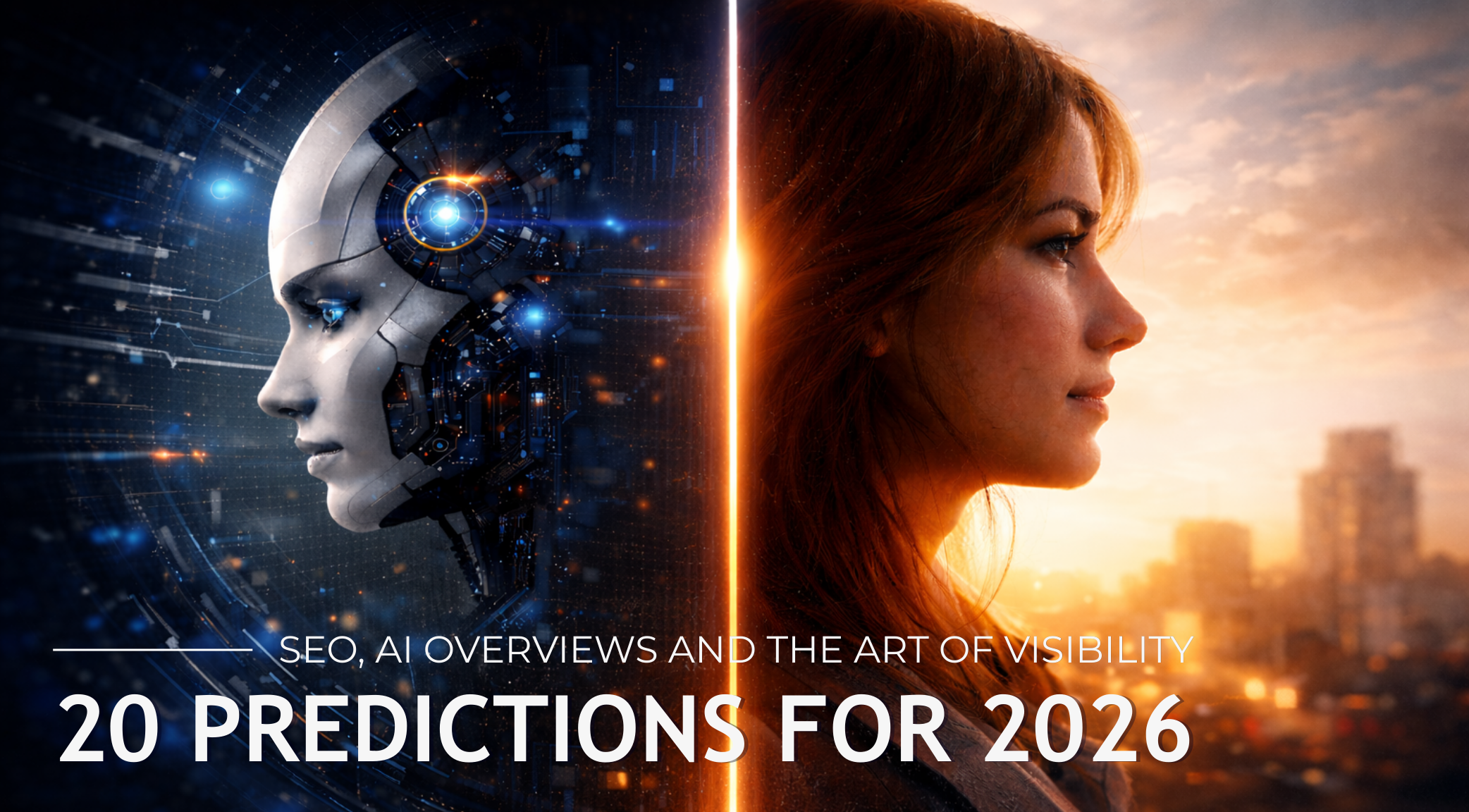
20 PREDICTIONS FOR 2026
2026 is not the year SEO dies. It is the year SEO stops being the whole game.
Search is shifting from a list of links to a layer of answers, summaries, and recommendations. AI Overviews are accelerating that shift, and the knock-on effect is simple: visibility is no longer only about where you rank, it is about whether you get selected as the source of truth.
In this new era, the brands that win will be UNDERSTOOD, REMEMBERED, AND CHOSEN.
Here are 20 predictions for 2026, across SEO, AI Overviews, and what we call the Art of Visibility:
- AI Overviews will expand and contract by industry. Some categories will see more AI coverage, others will see it reduced as accuracy and commercial sensitivity are tuned.
- Multi-step, research-driven intent will increasingly be resolved inside the search experience, not on ten separate tabs. ai
- The real battleground will be the second and third questions. If your content cannot carry the conversation forward, you lose the user journey.
- Citations will become a performance channel. Being referenced will become as strategic as being ranked.
- Top-of-funnel clicks will keep compressing, but the clicks that remain will be better qualified. Less traffic, higher intent.
- Entity clarity will outperform content volume. Brands with consistent identity signals will be summarised more accurately and surfaced more often.
- Answer architecture will beat long-form sprawl. Content designed to resolve intent fast, then branch logically, will win.
- Technical SEO will move from crawlability to interpretability. The advantage will come from making pages easy for machines to understand, not just easy to find.
- Schema will be most effective when it removes ambiguity about who you are, what you do, where you operate, and what proof exists.
- Brand SERPs will become brand summaries. Reputation management will increasingly mean managing what the engines say about you, not only what ranks.
- Proof will become the differentiator. Case studies, methodology, and transparent constraints will influence which sources are trusted.
- Content maintenance will become non-negotiable. Contradictions across pages will cost visibility.
- The web will split further into open and restricted layers as licensing and permissions tighten.
- Publishers will keep moving toward tools, community, and owned audiences as informational discovery is absorbed into AI layers.
- PR and SEO will converge into a citation strategy, planned around references that machines can reliably extract.
- Comparison content will become a primary acquisition asset, especially when it is honest about fit and trade-offs.
- Local and service discovery will become more narrative-led. Providers with clear service definitions and operational detail will be selected more often.
- Paid search will shift toward brand defence and mid-funnel capture as early discovery becomes more automated.
- Measurement will expand beyond rankings into presence, reference rate, answer rate, and narrative accuracy across generative surfaces.
- The 2026 winners will be the most legible brands. Not the loudest, not the most prolific, but the most consistent and evidence-backed.
If your strategy is still built only around rankings and traffic, you are optimising for yesterday’s internet.
The next advantage is being the source that AI systems trust enough to cite and humans trust enough to choose.