HAS YOUR BRAND GONE ALL PETE TONG?
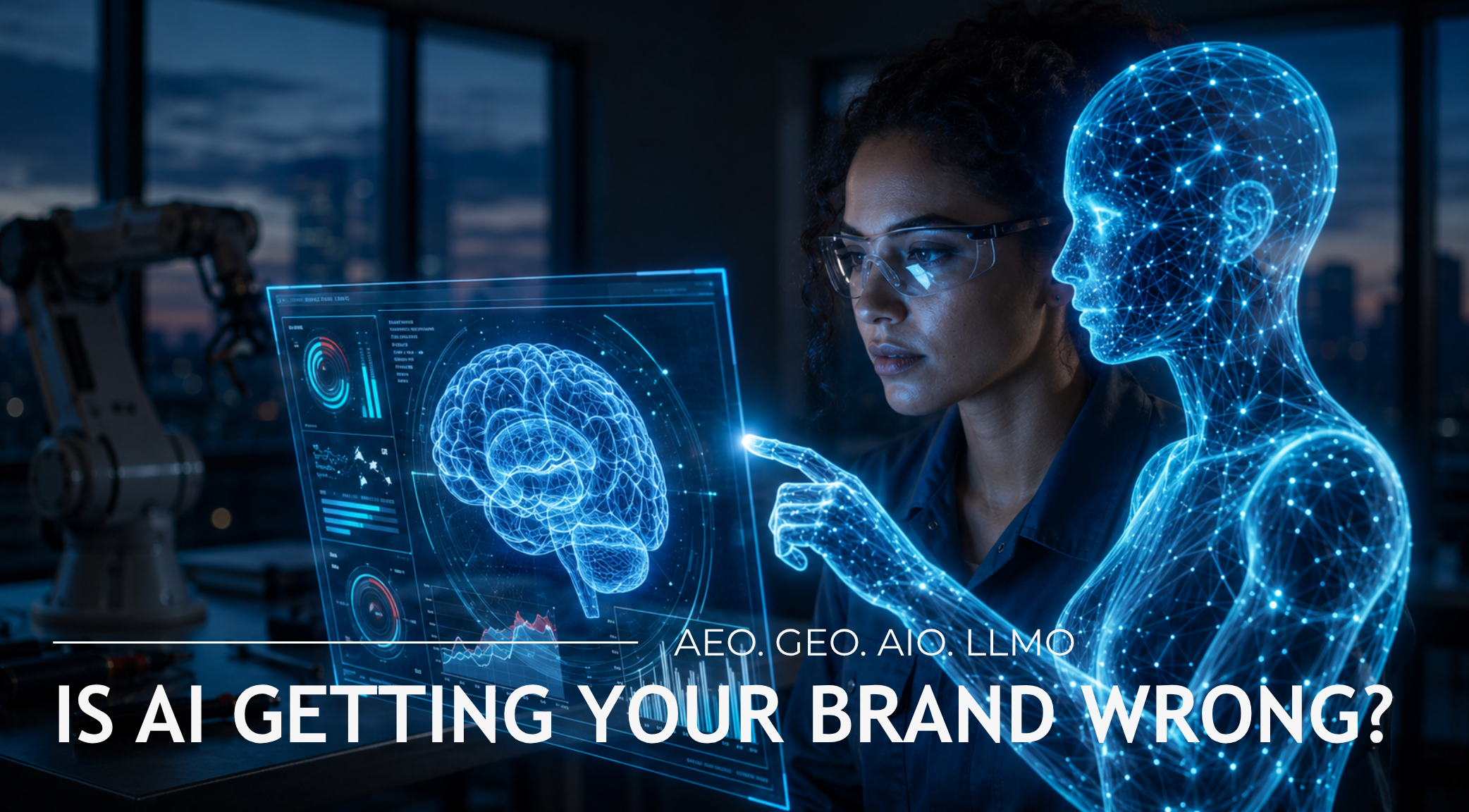
IS AI GETTING YOUR BRAND WRONG?
There was a time when brand visibility was mostly measured through rankings, traffic, impressions and clicks. If your website appeared on Google, your ads were running, your social media looked active and your brand appeared in the right places, you had a reasonable chance of being found, understood and chosen.
That world has not disappeared, but it has changed. Today, people are no longer only searching. They are asking. They are asking ChatGPT, Gemini, Perplexity, Claude, Copilot and other AI systems to explain, compare, summarise and recommend. They are asking which company to trust, which service to choose, which product is best, which provider is credible and which business seems most relevant to their need.
This means your brand is no longer being judged only by humans clicking through search results. It is also being interpreted by machines. And this creates one of the most important visibility questions of the AI era: is AI getting your brand right?
THE NEW BRAND RISK IS MISINTERPRETATION
Most businesses think their main digital problem is invisibility. They assume that if they are not getting enough leads, traffic or enquiries, the issue is that people are not finding them. That may still be true, but there is now a second, more subtle risk. Your brand may be visible, but misunderstood.
AI systems do not interpret your business the way a person does. They read your brand through the content, structure, signals, authority, citations, language and entities that exist across the web. They look at your website, third-party mentions, reviews, profiles, articles, schema, social presence, industry references and the broader digital footprint surrounding your name. From that, they form an answer.
That answer may be incomplete, outdated or too narrow. It may mention the wrong service, ignore your strongest offering, compare you unfairly with competitors or fail to cite you at all. Worse, it may confidently summarise your brand in a way that does not match who you are, what you do or why customers should choose you. This is not just an AI problem. It is a brand control problem.
WHEN AI GETS YOUR BRAND WRONG, BUYERS MAY NEVER KNOW
In traditional search, a user could still click through to your website and make up their own mind. They could read your pages, compare your services, view your proof points and decide whether you were the right fit. In AI search, the answer often arrives before the click.
A user may ask, “Who are the best providers for this service?” or “Which company should I use for this need?” or “What does this business specialise in?” The AI system may then provide a summary, a comparison or a recommendation-style response. If your brand is absent, you are invisible. If your brand is included but poorly explained, you are misrepresented. If your strongest proof points are missing, you are weakened. If your competitors are described more clearly, they become easier to choose.
This is where the commercial danger sits. The user may not know your brand has been misread. They may never visit your website to check. They may simply trust the answer and move on. In the AI era, a wrong summary can become a lost lead.
WHY AI GETS BRANDS WRONG
AI does not usually get brands wrong because it is trying to mislead people. It gets brands wrong because the available signals are weak, inconsistent, outdated or unclear. Many websites are still written for old search behaviour. They list services, use broad claims and hope the user understands the difference. But AI systems need more than service lists. They need clear entity signals, structured explanations, trustworthy context and content that answers specific questions.
A brand can be misread when its website does not clearly explain what it does, who it serves, where it operates, what makes it credible and how its services connect. A business can also be misunderstood when different platforms describe it differently. The website says one thing, Google Business Profile says another, LinkedIn is outdated, directory listings use old wording, reviews mention only one part of the business and articles may still reference past services. The result is a confused digital identity.
AI systems are built to interpret patterns. If the pattern around your brand is messy, the answer may be messy too.
SEO IS STILL THE FOUNDATION, BUT IT IS NO LONGER THE WHOLE BUILDING
Traditional SEO still matters. In fact, it matters more than ever. A technically sound website, strong content architecture, crawlable pages, indexable assets, internal linking, structured data and authority signals remain essential. But SEO now has to support a broader visibility system.
Your website must not only rank. It must explain. Your content must not only attract clicks. It must answer. Your brand must not only be present. It must be understood. This is where SEO, GEO, AEO, LLMO and optimisation for AI search engines begin to work together.
SEO helps search engines find and rank your content. GEO, or Generative Engine Optimisation, helps AI systems use, cite and summarise your content in generated answers. AEO, or Answer Engine Optimisation, helps your content become the clearest answer to specific questions. LLMO, or Large Language Model Optimisation, helps your brand become more understandable within the language patterns and entity relationships used by AI models. Optimisation for AI search engines helps your business appear correctly across AI-native discovery platforms such as ChatGPT Search, Perplexity, Gemini, Copilot and other emerging answer environments.
Together, these disciplines form the new visibility layer.
THE QUESTION IS NO LONGER ONLY “DO WE RANK?”
The better question is now: what does AI think we are?
That question may sound strange, but it is becoming commercially critical. When an AI system is asked about your business, does it describe you accurately? Does it understand your main services, market position, locations and areas of expertise? Does it connect your brand to the right industry topics? Does it cite your website or trusted third-party sources? Does it compare you fairly? Does it include your value proposition and understand why you should be chosen?
These are not theoretical questions. They are visibility questions. They affect how your brand is surfaced, summarised and selected in the environments where more buying decisions are beginning to form.
YOUR BRAND NEEDS TO BE MACHINE-READABLE AND HUMAN-MEANINGFUL
The future of digital marketing is not about writing only for machines. That would be a mistake. The goal is to build content that is meaningful to humans and readable to AI systems.
Your website still needs persuasive copy, strong design, clear offers, emotional relevance and conversion-focused pathways. But underneath that human layer, it also needs structured meaning. It needs clean service definitions, consistent entity language, answer-led content, schema, internal relationships, proof points and supporting authority.
A strong AI-optimised brand presence makes it easier for machines to understand what humans already should. It reduces ambiguity, improves recall, strengthens trust and gives AI systems better information to work with. Most importantly, it helps your brand become not only findable, but accurately represented.
THIS IS THE NEW ART OF VISIBILITY
At Macrocosm, we believe visibility is no longer just about being seen. It is about being seen correctly. That distinction matters.
A brand that appears in search but is misunderstood by AI is exposed. A brand that generates traffic but fails to shape machine interpretation is incomplete. A brand that is present online but not clearly connected to its expertise, authority and service relevance is leaving its future visibility to chance.
The Art of Visibility is now about helping brands become understood, remembered and chosen across both human and AI-driven discovery systems. That means building the right foundations across SEO, content, technical structure, AI search optimisation, answer readiness, entity clarity and digital authority.
It also means asking better questions. Not just, “How do we get more traffic?” but also, “How does AI describe us?” “Where are we missing from AI answers?” “Which parts of our brand are being misunderstood?” “What content does AI need to explain us properly?” “What proof does the market need to trust us?” and “What signals must we strengthen so that our brand is chosen more often?”
THE BRANDS THAT WIN WILL BE THE BRANDS AI UNDERSTANDS
AI is not replacing brand strategy. It is exposing weak brand strategy. It is exposing unclear messaging, thin content, poor structure, inconsistent positioning and outdated digital footprints.
Businesses that move early will have an advantage. They will not wait until AI search becomes the dominant discovery layer before correcting how they are represented. They will build clarity now, strengthen authority now and make their websites more answer-ready, entity-rich and AI-readable now.
Because the future of visibility will not belong only to the brands with the biggest budgets. It will belong to the brands that are easiest to understand, easiest to trust and easiest to recommend.
So, is AI getting your brand wrong? If the answer is unclear, that is already the signal. Your brand needs to be audited, structured and optimised for the way discovery now works. Not just for search engines, not just for users, but for the AI systems increasingly standing between the question and the chosen brand.