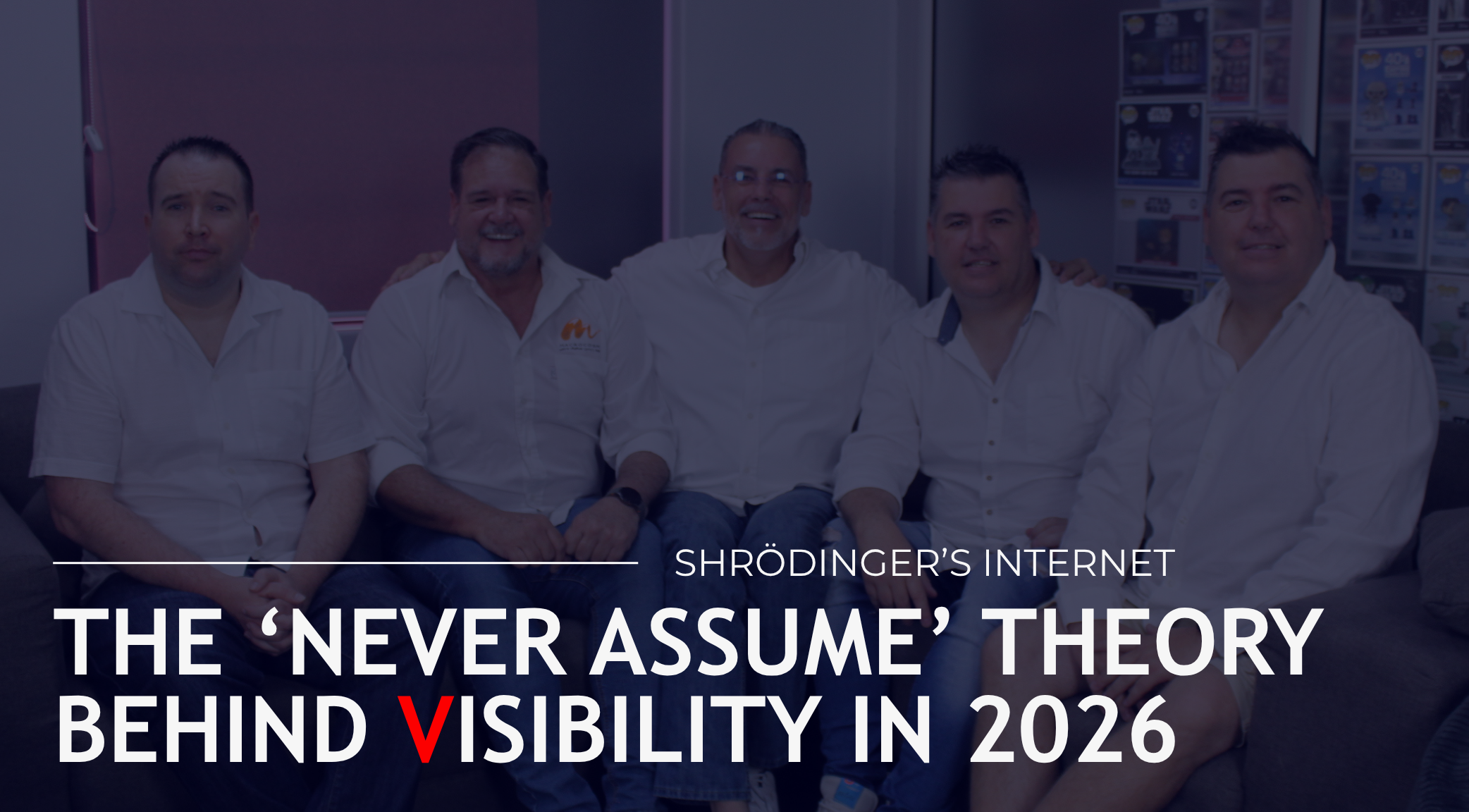
SCHRÖDINGER’S INTERNET: THE “NEVER ASSUME” THEORY BEHIND VISIBILITY IN 2026

There was a time when the internet felt reasonably simple to understand. A website ranked, or it did not. A page was indexed, or it was not. A business appeared in search results, or it remained hidden from view. Digital visibility was treated as something measurable, practical and fairly predictable. You could look at keyword rankings, organic traffic, backlinks, technical SEO health and conversion data, then form a reasonable view of where a brand stood in the market.

That version of the internet has not disappeared entirely, but it has changed fundamentally. The internet is no longer only a place where information is stored, crawled and retrieved. It has become an interpretive environment, where search engines, AI systems, answer engines, large language models, recommendation engines and voice assistants are constantly deciding what information means, which sources deserve trust, which brands deserve mention and which answers deserve to be shown.

This is the foundation of what we call Schrödinger’s Internet. It is a way of describing the new uncertainty of digital visibility. A brand can now exist in multiple states at the same time. It can be visible in traditional search, but invisible in AI-generated answers. It can rank well on Google, but still be poorly understood by ChatGPT, Gemini, Perplexity or Copilot. It can have traffic, but weak authority. It can be indexed, but not trusted. It can be mentioned online, but not remembered by AI systems.

In other words, a brand’s digital reality is no longer fixed by its existence alone. It is shaped by interpretation. Until an algorithm, AI model, answer engine or user observes and interprets the available signals, the brand exists in a state of probability. It may be trusted or distrusted, relevant or irrelevant, authoritative or ignored, clear or misunderstood. This is Schrödinger’s Internet, the internet as interpreted by machines.
In this new environment, one principle becomes critical: never assume.

Assumption Is Not Truth

Most businesses still build digital strategy on assumption. They assume their SEO is working because they have a website. They assume their content is clear because they understand what they meant when they wrote it. They assume Google understands their services because those services are listed somewhere on the site. They assume AI systems can interpret their business correctly because their brand exists online. They assume traffic means trust, rankings mean authority, schema means clarity and content means comprehension.

But assumption is not evidence. Assumption is belief without verification. It is opinion dressed up as certainty. It is what happens when a business accepts a convenient version of reality because it has not tested the actual one. In traditional digital marketing, assumption was already dangerous. In the age of AI, it becomes a liability.

The reason is simple. Machines do not fill gaps with loyalty, patience or common sense. They fill gaps with probability. When your website is vague, a machine infers. When your structure is weak, a machine approximates. When your authority signals are fragmented, a machine hesitates. When your brand identity is inconsistent across the web, a machine may connect your business to the wrong category, the wrong service, the wrong location or the wrong level of credibility.

That is where digital uncertainty begins. A human reader may forgive unclear language because they bring context, intuition and emotional understanding into the reading process. A search engine or AI system does not work in the same way. It reads signals, identifies patterns, compares entities, calculates confidence and interprets meaning through structure, repetition, association and authority.

If those signals are not clear, the machine does not wait for clarification. It decides. That decision may exclude your brand, misrepresent your service, cite a competitor, summarise your business incorrectly or make your brand invisible inside the very answers your customers are beginning to trust. This is why the “Never Assume” Theory matters. At Macrocosm, we believe assumption is the death of visibility.

The Internet Has Moved From Retrieval To Interpretation

For many years, digital strategy was built around retrieval. A person entered a query, a search engine returned a list of pages, the user selected a result, visited a website and made a decision. The job of SEO was to help the right page appear in the right place for the right query.

That is still important. SEO is not dead. It is not less important. In many ways, it is more important because it supplies the structured foundation upon which AI visibility depends. Technical SEO, site architecture, content depth, crawlability, indexation, internal linking, page performance, backlinks and authority signals still matter deeply.

What has changed is that retrieval is no longer the whole story. Modern discovery is increasingly shaped by interpretation. Search engines now summarise content. AI systems generate answers. Generative engines compare sources. Answer engines extract direct responses. Voice assistants condense information into a single spoken result. Large language models construct answers from patterns, context and probability.

This changes the role of digital content. Your content is no longer only competing to be clicked. It is competing to be understood. Your website is no longer only being crawled. It is being interpreted. Your brand is no longer only being indexed. It is being evaluated as an entity within a wider knowledge environment.

The old question was, “Can Google find you?” The new question is, “Can machines correctly understand you?” Those are very different digital problems. A business can be found without being understood. It can appear in a search result without being trusted by AI. It can generate traffic without becoming a reliable entity. It can publish content without creating clarity. This is the difference between being searchable and being machine-readable.

What Schrödinger’s Internet Really Means

Schrödinger’s Internet borrows from the famous thought experiment associated with quantum uncertainty. In simple terms, Schrödinger’s Cat describes a scenario where a cat inside a sealed box can be considered both alive and not alive until observed. The act of observation resolves the uncertainty.

In the digital world, something similar is happening to brand visibility. A brand can exist in multiple possible visibility states until observed by a search engine, AI system, answer engine or user. Its meaning is not always stable. Its authority is not always universally recognised. Its relevance may vary across platforms. Its visibility may shift depending on the query, prompt, model, data source, location, context and confidence level of the interpreting system.

This means a brand can be visible in Google, but invisible in AI answers. It can be indexed by search engines, but misunderstood by large language models. It can be known by customers, but unclear to machines. It can be relevant to a topic, but not semantically connected strongly enough. It can be mentioned online, but not confidently cited.

Your brand may feel visible because you can see your website, rankings, posts, ads and analytics. But visible human-facing signals do not automatically mean that AI systems understand your business correctly. This is where many companies will lose ground over the next decade. Not because they have no digital presence, but because their digital presence does not reduce uncertainty.

In Schrödinger’s Internet, the brand that has not been clearly interpreted has not fully become visible.

Visibility Is Now Contextual, Interpretive And Probabilistic

One of the most important shifts in the AI era is that visibility is no longer singular. A business may be highly visible in one context and completely absent in another. It may rank for a traditional Google query, but fail to appear when a user asks ChatGPT for recommended providers. It may appear in Perplexity for a broad question, but not for a commercial comparison prompt. It may be visible in organic results, but missing from AI Overviews. It may be known for one service, but not understood for its broader offering.

This is why modern visibility is contextual. It depends on what is being asked, who is asking, where they are asking, which system is interpreting the query and what confidence signals are available at the moment of interpretation. A search query, an AI prompt and a voice assistant request are not the same thing. A keyword asks for retrieval. A prompt asks for synthesis. A voice query asks for simplification. A comparison query asks for judgement. A recommendation query asks for trust.

Visibility is also interpretive. Search engines and AI systems are not simply asking whether your content exists. They are asking what it means. They are trying to understand the relationship between your brand, your services, your industry, your location, your authority, your content, your reputation and the user’s intent.

This is why vague content is becoming more dangerous. A page that says “we offer quality solutions for businesses” may sound acceptable to a human marketing team, but it gives machines very little to interpret. What solutions? For whom? In which location? With what proof? Under which service category? Connected to which problems? Supported by which evidence?

Machines need clarity, specific relationships, clean structure, entity reinforcement, evidence and consistency. When that clarity is missing, they infer meaning. When they infer meaning, the brand loses control.

Visibility is also probabilistic. Large language models and AI search systems operate through likelihood, confidence and association. They do not always produce answers by retrieving a single fixed page. They may generate answers by synthesising multiple signals, sources and patterns. This means your brand’s visibility depends partly on how likely a system is to associate your brand with the right service, trust your authority and connect your content to the user’s intent.

SEO, GEO, AEO, AIO And LLMO

The future of visibility requires a connected approach. SEO remains the foundation because it helps search engines crawl, index, rank and evaluate a website. It supports technical structure, keyword relevance, authority, content depth and organic performance. Without strong SEO, the wider AI visibility layer becomes weaker.
But SEO now needs to work alongside GEO, AEO, AIO and LLMO.

GEO, or Generative Engine Optimisation, focuses on how generative AI systems interpret, summarise and cite brand content. It is concerned with whether your business can be included inside AI-generated answers, not merely ranked beside them.

AEO, or Answer Engine Optimisation, structures content so that direct answers can be retrieved, extracted and presented clearly. It focuses on questions, definitions, comparisons, procedures, summaries and concise explanations that answer engines can use.

AIO focuses on optimisation for AI-native search environments. It strengthens entity relationships, semantic clarity, contextual relevance and the ability of AI systems to understand who you are, what you do and why you matter.

LLMO, or Large Language Model Optimisation, focuses on improving how large language models recall, describe and represent your brand. It aims to reduce hallucination risk, improve summary fidelity and minimise semantic confusion.

These disciplines are not separate islands. SEO makes the brand findable. GEO makes the brand generative. AEO makes the brand answerable. AIO makes the brand understandable to AI-native systems. LLMO makes the brand more stable inside large language model interpretation. Together, they reduce uncertainty, and in Schrödinger’s Internet, reducing uncertainty is the new competitive advantage.

The ‘Never Assume’ Framework

The Never Assume Framework is a practical philosophy for brands operating in the age of AI. Never assume your website is understood simply because it is live. It must be structured, labelled, internally connected, technically sound and semantically clear. Never assume rankings equal authority, because ranking for a keyword does not automatically mean AI systems recognise your brand as a trusted entity.

Never assume traffic equals trust. Traffic shows that people arrive, but it does not prove that machines understand, trust or recommend your business. Never assume content creates clarity automatically. A page may contain many words and still fail to answer the right questions. Never assume AI interprets intent correctly, because AI systems infer intent from the signals available. Weak signals create weak interpretation.

Never assume schema is correct simply because it exists. Schema must be accurate, relevant and aligned with the actual content on the page. Never assume machines trust ambiguity. Ambiguity may sound creative to humans, but it creates uncertainty for machines. Never assume discoverability guarantees inclusion, because a brand can be discoverable in search and still excluded from AI answers, summaries and recommendations.

The alternative is evidence. Verify the structure. Test the interpretation. Strengthen the entities. Clarify the services. Improve the answers. Align the signals. Reduce the uncertainty. That is the practical heart of the Never Assume Theory.

The Future Belongs To The Clearest Brands

The Art of Visibility is no longer only about being found. It is about being understood, remembered and chosen. Being found is a retrieval outcome. Being understood is an interpretation outcome. Being remembered is an entity outcome. Being chosen is a trust outcome.

The brands that succeed in the AI era will be those that connect all four. They will create websites that humans can navigate and machines can interpret. They will publish content that answers questions clearly. They will build authority that is visible across the wider web. They will use structured data to clarify meaning. They will align SEO, GEO, AEO, AIO and LLMO into one operating system.

The first step is to stop assuming. Do not assume your website is clear. Audit it. Do not assume your content is answer-ready. Test it. Do not assume AI systems understand your services. Ask them. Do not assume that ranking means inclusion. Check AI answers. Do not assume that your brand is being represented correctly. Monitor summaries.

The internet is changing from a place of retrieval into a place of interpretation. A brand is no longer visible simply because it exists online. It becomes visible when it can be found, understood, trusted, summarised, cited and recommended across human and machine environments.

That is why Schrödinger’s Internet matters. Your brand may be visible and invisible at the same time. Trusted and distrusted. Indexed and ignored. Present and absent. Clear to you, but unclear to the systems deciding whether you deserve inclusion.

The businesses that win the next decade will not be those that assume they are understood. They will be the businesses that prove it. They will reduce ambiguity, strengthen semantic trust, build clear entity relationships, structure content for answers and optimise for search engines, generative engines, answer engines, AI-native systems and large language models.

In Schrödinger’s Internet, uncertainty weakens visibility. Clarity strengthens it. Certainty becomes a competitive advantage. At Macrocosm.London, we do not optimise for assumptions. We optimise for understanding.

That is where The Art of Visibility begins.

Share this post


Kevin Silver

Chief Executive Officer | Visionary in AI-Driven Visibility

Kevin Silver is the CEO of Macrocosm.London Ltd in the United Kingdom, and Macrocosm Ultra Digital (Pty) Ltd in South Africa, both premier agencies at the forefront of digital visibility. As a results-driven business strategist, Kevin specialises in SEO, Google Ads, social media, and web development, but his true strength lies in anticipating the next frontier of search.

Kevin is a recognised thought leader in GEO (Generative Engine Optimisation), AI SEO, AEO (Answer Engine Optimisation), and LLMO (Large Language Model Optimisation). He coined the practical use of THE ART OF VISIBILITY, how often AI tools cite your brand, as a new key metric of being cited, served and discovered. His work helps brands move beyond traditional click-throughs into AI-native presence, where discoverability depends on being referenced within answers provided by ChatGPT, Perplexity, Gemini, and similar models.

Rooted in the philosophy of ‘The Art of Visibility’, Kevin leads a growing movement in London and Southern Africa, that aligns technical innovation with human-centric brand storytelling. By publishing, speaking, and educating early on these shifts, he ensures his clients and peers are not only prepared, but thriving, in the AI-powered landscape of tomorrow.

This will close in 0 seconds

Richard Silver

Chief Financial Officer

Richard Silver is the Chief Financial Officer of Macrocosm.London Ltd in the United Kingdom, and Macrocosm Ultra Digital (Pty) Ltd in South Africa, leading financial strategy across both agencies at the forefront of digital visibility. With over 15 years in the digital marketing industry, Richard’s expertise spans finance, operations, and performance-driven marketing. His approach blends analytical precision with strategic insight, ensuring every initiative delivers measurable ROI and long-term value.

Richard oversees both the Finance and SEO divisions, a rare combination that allows him to align financial stewardship with the technical demands of high-impact visibility campaigns. His commitment to staff wellbeing is an admirable trait, fostering a supportive and motivating environment that empowers the team to excel. He holds a B.Comm Diploma in Financial Management from Stellenbosch University and has achieved multiple Google-accredited certifications, including Google Ads Professional status. And, according to his wife Thara-Lee, he’s also “a bit of a hubba hubba.”

This will close in 0 seconds

Joe Labuschagne

Chief Operating Officer

Joe is the Chief Operations Officer of Macrocosm.London Ltd in the United Kingdom and Macrocosm Ultra Digital (Pty) Ltd in South Africa, overseeing the daily operations that keep both agencies performing at the highest level. With more than 25 years of executive management experience, including over a decade at Macrocosm, Joe combines operational precision with people‑first leadership.

For Joe, being in charge of the team is not about holding a title, it is about being a leader. He believes in empowering his team and creating an environment where every person has the opportunity, resources and support to excel. His leadership is rooted in genuine care for his staff, ensuring they have the guidance to grow professionally while achieving their own personal goals.

Joe holds a Bachelor of Commerce degree from UNISA and an MBA from the University of North Carolina at Chapel Hill. He complements his academic foundation with nine Google accredited certifications, keeping him attuned to the latest industry innovations and ensuring Macrocosm’s operations evolve in step with the fast changing digital landscape.

This will close in 0 seconds

Thara-Lee Stroebel

Finance and HR Manager

Thara‑Lee is the Finance and HR Manager of Macrocosm.London Ltd in the United Kingdom and Macrocosm Ultra Digital (Pty) Ltd in South Africa. With more than 22 years of experience in finance and administration, including 10 years in the United Kingdom, she brings a wealth of knowledge to the fast‑paced world of digital marketing.

After returning to South Africa, Thara‑Lee worked in the finance department of an IT company that manufactured Proline computers before moving into the marketing sector as a finance assistant, where she also supported website process flows and content management. She joined Macrocosm in March 2017 and has been an integral part of the company ever since.

In her role, Thara‑Lee manages the company’s financial operations while also serving as HR Manager. She is deeply committed to staff wellbeing, fair workplace practices and fostering a supportive, people‑first culture. Her First Aid Level 1 certification further reflects her dedication to maintaining a safe and positive working environment. With her extensive experience, ongoing commitment to learning and strong sense of accountability, Thara‑Lee ensures that both the numbers and the people behind them are supported for long‑term success.

This will close in 0 seconds

Christopher Silver

Strategic Partner

Christopher Silver is a Strategic Partner of Macrocosm.London Ltd in the United Kingdom and Macrocosm Ultra Digital (Pty) Ltd in South Africa. Drawing on his extensive experience in business management, customer care and retail strategy, Christopher brings a unique commercial perspective to Macrocosm’s growth and client partnerships.

Alongside his brothers Kevin and Richard Silver, Christopher is also a driving force behind Silver Toy Shop, a family‑owned business renowned for its passion for pop culture, rare collectibles and high‑quality Funko Pops. His years of experience as Council Manager for the Motor Vehicle Department in South Africa, combined with his deep understanding of retail operations, have equipped him with a sharp eye for identifying opportunities and building customer‑centric strategies.

At Macrocosm.London, Christopher’s role as a strategic partner focuses on exploring new business opportunities, fostering long‑term relationships and bringing a commercially‑minded lens to visibility strategies. His ability to bridge operational insight with market‑driven thinking ensures that Macrocosm remains agile, relevant and positioned for sustained success in a fast‑evolving digital landscape.

This will close in 0 seconds

Steve Hughes

Strategic Partner

Steve is a Strategic Partner of Macrocosm.London Ltd in the United Kingdom and Macrocosm Ultra Digital (Pty) Ltd in South Africa. With more than 12 years of experience delivering SaaS, hospitality, publishing and digital marketing projects, Steve specialises in guiding distributed teams to deliver high‑quality results on time and within scope.

As an experienced Remote Project Manager, Scrum Master and Agile Coach, Steve thrives at the intersection of people, process and technology. He is skilled at facilitating collaboration, removing obstacles and ensuring cross‑functional alignment between design, technical and business stakeholders. His leadership keeps teams energised, focused and working seamlessly across time zones.

At Macrocosm.London, Steve brings his expertise in backlog management, stakeholder engagement and remote team leadership to support strategic initiatives and large‑scale delivery. His ability to combine agile methodologies with practical business insight ensures that projects run efficiently while fostering a culture of continuous improvement. Steve’s commitment to process excellence and collaborative delivery makes him a valuable strategic partner in helping Macrocosm’s clients achieve their visibility and growth goals in an ever‑evolving digital landscape.

This will close in 0 seconds

Glenn Ormandy

Marketing Manager

Glenn is the Marketing Manager of Macrocosm.London Ltd in the United Kingdom and Macrocosm Ultra Digital (Pty) Ltd in South Africa. With a career that began in IT software support, Glenn built a strong technical foundation before moving into the fast‑paced world of digital marketing. His early experience included managing the website and social media accounts for ROCKNROLLA Magazine in Oslo, Norway, while studying .NET C# programming and Pastel Partner Accounting Software.

Glenn later joined a growing digital marketing agency where he managed multiple marketing accounts and led new website builds. In 2016, he brought his expertise to Macrocosm, where his deep understanding of search engines and technical marketing quickly made him an essential part of the team.

Today, Glenn leads marketing operations with a focus on Google Ads and SEO strategy. His campaigns are grounded in data, driven by insight and refined with meticulous attention to detail. With a broad knowledge of industries and a passion for delivering measurable results, Glenn ensures every campaign is strategically sound and performance‑driven. Glenn’s leadership in marketing helps position Macrocosm.London’s clients for visibility, growth and long‑term success in an ever‑changing digital landscape.

This will close in 0 seconds

Danielle Swanepoel

Traffic Manager

Danielle is the Traffic Manager of Macrocosm.London Ltd. With over a decade of experience at Macrocosm, she brings a wealth of operational knowledge and marketing expertise to the London team.

She began her journey with the agency in its early years, working across multiple departments from office administration and executive assistance to web traffic management. Today, she leads traffic operations for the Web Department in London, coordinating projects, managing deadlines and ensuring smooth workflows between creative, technical and strategic teams.

Danielle’s skill set spans search engine optimisation (SEO), Google Ads, reporting, website development and social media management. She has earned numerous industry certifications, including Google Ads (Search, Shopping, Display), Google My Business Basics, Digital Sales, YouTube Creative Essentials, all 86 Facebook Blueprint courses and First Aid Level 1.

Her ability to blend operational precision with marketing insight ensures that every project at Macrocosm.London runs efficiently, on schedule and to the highest standard.

This will close in 0 seconds

Jayde Wacker

Social Media Manager

Jayde is the Social Media Marketing Manager of Macrocosm.London Ltd. Since 2018, she has developed from a passionate content creator into a highly skilled digital marketing professional, bringing creativity, strategic insight and hands‑on expertise to the London team.

Her career began in content writing, where her talent for storytelling and strategic thinking quickly became evident. Over time, she expanded her skill set to include website traffic management, graphic design, WordPress development and project management. Today, she leads Macrocosm.London’s social media department, delivering high‑impact, trend‑driven campaigns that enhance brand visibility and engagement.

Jayde is self‑taught in design, holds multiple certifications from Google and Meta, and has completed formal training in digital marketing through the University of Cape Town. Her broad experience across disciplines allows her to combine creativity with technical precision, ensuring every campaign is both innovative and results‑driven.

This will close in 0 seconds

Madison Parkins

Lead Designer

Madison is the Lead Designer of Macrocosm.London Ltd. Since 2021, she has been creating high‑impact visual solutions for clients, combining over five years of experience in digital marketing, social media and graphic design. She holds a BA in Graphic Design and has built her career on delivering creative work that is both visually compelling and strategically aligned.

Specialising in UX design, Madison is passionate about crafting user‑focused experiences that blend creativity with functionality. She stays at the forefront of design trends, ensuring Macrocosm.London’s clients benefit from fresh, modern and effective visual communication.

Her work has played a key role in expanding the agency’s web department, bringing new perspectives and a refined creative approach to the team. Madison’s dedication to learning, innovation and attention to detail ensures that every design she produces supports the client’s broader visibility and brand goals. By combining strategic thinking with creative execution, Madison helps position Macrocosm.London’s clients for stronger engagement, clearer brand presence and lasting visual impact.

This will close in 0 seconds

Kaitlin Craven

Web Developer and Designer

Kaitlin is a Web Designer and Developer at Macrocosm.London Ltd. She specialises in creating clean, fast and intuitive digital solutions that support marketing strategies and drive business growth. Her work focuses on building user‑friendly websites and custom tools that perform seamlessly across devices.

She holds a Bachelor of Information Technology in Web Design and Development, graduating cum laude as the top student in her class. Kaitlin joined Macrocosm while completing her studies, gaining hands‑on experience that strengthened her problem‑solving skills, technical expertise and ability to collaborate effectively across teams.

With a commitment to staying current with emerging technologies, Kaitlin ensures her work remains relevant, innovative and effective. Whether refining a user journey, optimising site performance or exploring new tools, she approaches each project with precision and purpose. Her ability to combine technical skill with a focus on user experience makes Kaitlin a valuable part of Macrocosm.London’s web department, helping clients achieve both functional and visually impactful digital presences.

This will close in 0 seconds

Nathan Just

Web and App Developer

Nathan is a Web and App Developer at Macrocosm.London Ltd. He specialises in building seamless, functional and visually engaging digital solutions, combining expertise in both front‑end and back‑end technologies.

He holds a Bachelor’s degree in Web Design and Development, giving him a strong technical foundation to deliver high‑performance websites and applications. At Macrocosm.London, Nathan focuses on developing clean, efficient code, troubleshooting complex issues and implementing modern solutions that meet industry best practices.

Nathan thrives in dynamic environments where innovation and problem‑solving are essential. He keeps ahead of emerging trends in development, ensuring every project is optimised for speed, mobile responsiveness and user experience. Whether he is creating custom features, enhancing performance or refining user journeys, Nathan approaches each project with precision and purpose. His ability to merge technical skill with creative problem‑solving makes him a valuable member of Macrocosm.London’s development team, helping clients achieve smarter, faster and more engaging digital experiences.

This will close in 0 seconds

Kyla Brinders

Digital Marketer

Kyla is a Digital Marketer at Macrocosm.London Ltd. She plays a key role in developing and implementing strategies that help clients strengthen their online presence and achieve measurable results.

She holds a Bachelor's degree of Commerce in Digital Marketing. Her work spans multiple areas of digital marketing, including content creation, social media management, search engine optimisation (SEO) and paid advertising campaigns. Kyla combines creative thinking with data‑driven decision‑making, ensuring every campaign is both visually engaging and strategically aligned with client goals.

With a keen interest in the evolving digital landscape, Kyla stays up to date with emerging trends and tools to ensure her work remains innovative and effective. She works closely with the wider Macrocosm.London team to create cohesive marketing strategies that drive visibility, engagement and growth.

This will close in 0 seconds

Rutendo Chemumwe

Digital Marketer

Rutendo is a Digital Marketer at Macrocosm.London Ltd. She brings a strong blend of creativity, strategy and technical expertise to developing and managing digital campaigns for a wide range of clients.

Her work spans content creation, search engine optimisation (SEO), social media management and paid advertising. Rutendo is known for her ability to craft persuasive, platform‑appropriate messaging that aligns with each client’s brand voice and goals. From website copy and blog articles to social posts and Google Ads, her work is designed to engage audiences and drive measurable results.

At Macrocosm.London, Rutendo manages campaign planning, content production and performance optimisation, ensuring consistent, high‑quality output across all projects. She collaborates closely with both clients and internal teams to deliver marketing strategies that build visibility and strengthen online presence. Her ability to manage multiple projects with precision, while maintaining a results‑driven focus, makes Rutendo a valued member of the Macrocosm.London team and a key contributor to client success.

This will close in 0 seconds

Teneal Van Der Merwe

Digital Marketer

Teneal is a Digital Marketer at Macrocosm.London Ltd. Currently completing her studies in graphic design, she brings a fresh perspective and a strong creative eye to the marketing team. Her work blends design principles with digital marketing strategy, ensuring content is both visually engaging and aligned with client goals.

Teneal contributes to both the marketing and social media departments, applying her skills in photography, content creation and visual storytelling. She has a natural talent for capturing impactful imagery that enhances brand narratives across multiple digital platforms.

Her dedication to learning and her willingness to take on new challenges make her a valued member of the Macrocosm.London team. Teneal approaches every project with enthusiasm, creativity and a commitment to producing high‑quality work that supports client visibility and engagement. With her growing expertise and hands‑on experience, Teneal is building a strong foundation for a successful career in design and digital marketing.

This will close in 0 seconds

Carlo Bosman

Digital Marketer

Carlo is a Digital Marketer at Macrocosm.London Ltd. With a background in software engineering and hands‑on experience in web design and search engine optimisation (SEO), he combines technical expertise with creative thinking to deliver engaging online experiences that drive measurable results.

Since beginning his career in digital marketing in 2022, Carlo has built skills in website development, SEO strategy and content optimisation. He holds a Software Engineering Certificate and has completed Google’s Introduction to SEO, equipping him with a solid foundation to support client visibility and performance goals.

Before moving into digital marketing, Carlo worked as an administrative assistant at a brokerage, developing strong organisational and client‑facing skills. Today, he applies the same attention to detail and commitment to quality in his work at Macrocosm.London, ensuring every project meets both technical and strategic objectives. Carlo is dedicated to continuous learning, refining his skills and staying current with industry trends. His focus on combining functionality, design and data‑driven strategy makes him a valuable contributor to the Macrocosm.London team and to the success of its clients.

This will close in 0 seconds

JP Labuschagne

Sales Executive

JP is a Sales Executive at Macrocosm.London Ltd. With over 12 years of experience in sales and management across multiple industries, he brings strategic insight, in‑depth knowledge and a strong results‑driven mindset to every client engagement.

JP specialises in identifying tailored digital marketing solutions that drive measurable outcomes. His ability to connect with clients, understand their goals and deliver strategies that work has made him a trusted partner to businesses seeking growth in the competitive digital landscape.

He has completed several industry‑recognised certifications, including Google My Business Basics, Digital Sales and Google Ads (Search, Shopping and Display), ensuring he stays at the forefront of digital marketing trends and best practices. Approachable, professional and committed to client success, JP plays a key role in helping Macrocosm.London’s clients achieve meaningful visibility, engagement and long‑term growth.

This will close in 0 seconds

Get a free SEO audit report for your website

We will email you a PDF report that will show the SEO issues which, when solved, will improve your site rankings and increase traffic to your website.

This will close in 0 seconds

Ads Audit

"*" indicates required fields

This field is for validation purposes and should be left unchanged.

This will close in 0 seconds